
Losing teeth can significantly affect the remaining teeth. Your dentist will strongly recommend replacing missing teeth as soon as possible after their removal. Several solutions are available, including a dental bridge.
At 505 Dental Associates, patients can learn about tooth replacement options and find a solution suited to their individual needs.
In this article, learn more about the different types of bridges, when they are used, and another alternative, which is to have dental implants.
What is a Dental bridge?
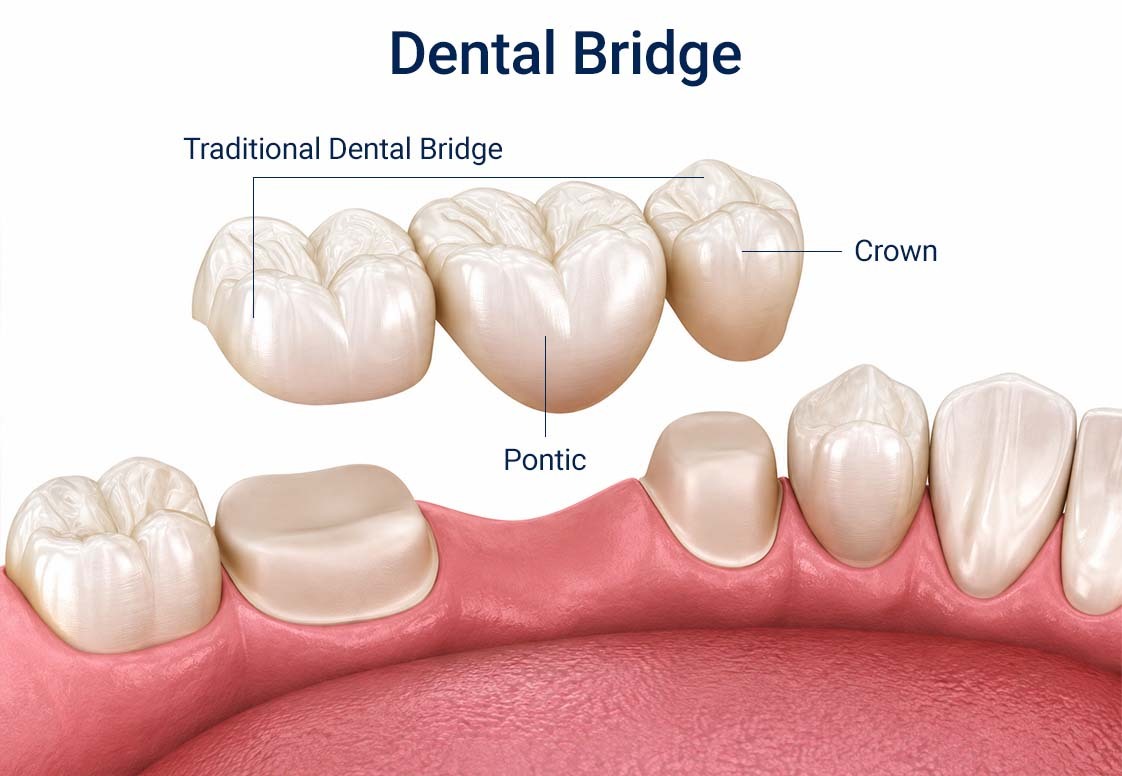
A dental bridge is designed to “bridge” the gap created when you lose teeth. It can replace one or more teeth originally adjacent to each other and is supported by your natural teeth.
With a traditional dental bridge, the natural teeth on either side of the gap, called abutment teeth, must be covered with dental crowns. The crowns anchor the bridge in place, and replacement teeth called pontics are attached between them.
A pontic is shaped to represent a natural tooth, allowing you to bite and chew food comfortably and smile confidently. The pontic rests directly on your gum.
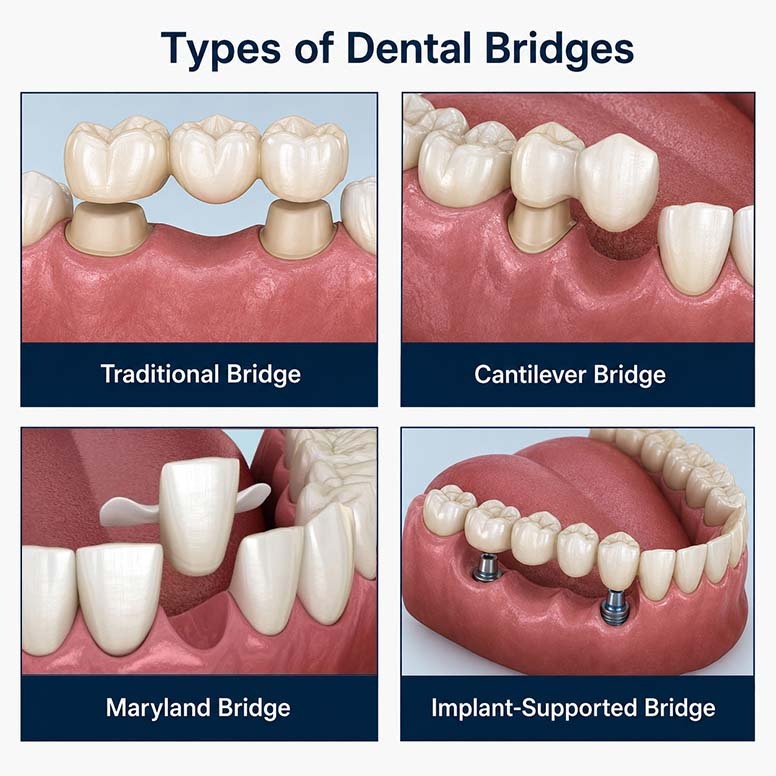
There are several types of dental bridges available. Your dentist may recommend a traditional bridge, a cantilever bridge, or a Maryland bridge.
Read More: Are There Any Less Invasive Alternatives to Dental Implants?
Traditional Bridge
A traditional bridge is as described above, so you need to have strong, healthy teeth on either side of the gap capable of supporting the bridge.
What to Expect If You Have a Traditional Bridge?
Your abutment teeth are substantially reshaped during treatment, preparing them for crowns. This part of the treatment is completed using a local anesthetic to ensure you cannot feel a thing.
Once your teeth are reshaped, your dentist takes a dental impression to fabricate your dental bridge in the dental lab.
While your bridge is made, your dentist will fit a temporary restoration to protect your prepared teeth. It can take two weeks or more to make the bridge.
Once the bridge is ready, you simply return to your dental office so the temporary restoration can be removed and your new permanent bridge can be tried in, adjusted if necessary, and cemented in place.
Cantilever Bridge
You may need a cantilever bridge if you only have abutment teeth suitable for crowning on one side of the gap. Your dentist may crown one or two teeth on the same side to provide enough support.
What to Expect If You Have a Cantilever Bridge?
The procedure is the same as for a traditional bridge. However, a cantilever bridge is only suitable in certain circumstances and cannot provide a biting and chewing strength similar to that of an ordinary traditional bridge. Therefore, a cantilever bridge may be more commonly used to restore missing front teeth that are not under significant pressure during biting and chewing.
Read More: 11 Reasons Why Your Tooth Hurts When You Bite Down
Maryland Bridge
A Maryland bridge replaces small incisors, such as a lower front tooth. Instead of crowns that fit over the abutment teeth, wings are fabricated that fit over the inner surfaces of each abutment tooth. The wings are cemented onto these inner surfaces, supporting the pontic between them.
What to Expect if You Have a Maryland Bridge?
Maryland bridges are quite fragile and can withstand substantial biting forces. They may become unstuck and will require re-cementing in your dental office. However, little or no tooth preparation is needed. Your dentist must etch the tooth surfaces underneath each wing, slightly roughening the surfaces to create a stronger bond between the wing and the tooth.
How to Take Care of a Dental Bridge
After you have a dental bridge, properly taking care of it is vital. You must floss around each abutment tooth and thoroughly clean your dental crowns. You must also floss underneath each pontic. You may need special tools to achieve this task; a water pik can be highly effective.
What Are the Pros and Cons of a Dental Bridge?
Advantages include:
- A dental bridge supported by your natural teeth is a quick and relatively non-invasive way to restore missing teeth. Your dentist can make and fit the bridge within just a few weeks once your gums have healed following tooth extraction.
- It’s an ideal solution if you want to replace missing teeth fast, provided you have abutment teeth that are strong enough to support the bridge.
Disadvantages can include:
- Your dentist may need to reshape perfectly healthy and strong teeth in preparation for dental crowns. Removing healthy tooth structure is always undesirable as it will not grow back.
- A dental bridge is not a permanent solution as eventually it will need replacing. Your dentist will need to check its condition regularly, as when it starts to age, it may start to leak. If this happens and you don’t replace the dental bridge promptly, the teeth underneath the dental crowns could become infected and decay.
- A dental bridge doesn’t do anything to protect your jawbone. The gum and bone underneath each pontic will gradually resorb after your natural teeth are removed. Eventually, this could create unsightly gaps underneath each pontic.
What Are the Alternatives to Having a Dental Bridge?
A good alternative worth considering is to have dental implants. An implant offers a permanent solution for tooth loss and has some significant advantages.
Unlike a dental bridge, a dental implant is self-supporting, so there is no need for your implant dentist to reshape perfectly healthy teeth. An implant has a small post surgically inserted into your jawbone, supporting the replacement tooth. Your implant dentist can use several dental implants to support large-span bridges or even a complete arch of teeth.
Dental implants are the only tooth loss solution that can help protect your jawbone because they closely replicate real tooth roots. They provide a similar stimulation level, ensuring bone cells are renewed as they die.
With dental implant teeth, you will enjoy a biting and chewing strength similar to natural teeth. You can eat just about anything you like with dental implant teeth.
Read More: What Is Orthodontics?
Suitable for Most People
Most people are suitable for dental implants, but you must have reasonable dental and general health. Ideally, if you are considering implants, see a dental implant dentist with advanced training, such as a periodontist.
Periodontists complete several years of additional training after first qualifying as a general dentist. Their advanced training includes dental implantology, so they have the necessary skills to plan and place even the most complex dental restorations.
Their dental offices have the high-tech equipment needed for computer-guided dental implants, including a cone beam CT scanner so you can receive all the treatment you need under one roof.
A periodontist can also complete other treatments you may need during your dental implant procedure, such as gum and bone grafting. These procedures can be necessary if you lost teeth some time ago and where gum and jawbone resorption have already occurred.
Read More: Front Teeth Crowns Vs. Veneers
Contact Your Local Periodontist to Schedule Your Consultation
At 505 Dental Associates, patients in Claremont and Co-op City can schedule an initial consultation for dental implants. You don’t need a referral from your general dentist; you can book directly with our practice. During your initial appointment, you can learn if you are likely suitable for dental implants, which options are available, and the potential costs.