
When you meet someone for the first time, one of the things they initially notice is your smile. Studies have shown that people can sometimes make up their mind about someone within a few seconds of meeting them, and if you are less than confident about showing your teeth, they could reach the wrong conclusion.
At 505 Dental Associates, patients can explore dental solutions designed to improve the appearance and function of their smiles.
Front teeth can often become damaged, and it’s not unusual to chip or crack a tooth if you take a blow to the mouth during sports or because of some other form of trauma. Crowns and veneers are often used to repair, restore, and protect front teeth. They are also frequently used during smile makeovers.
However, crowns and veneers are very different restorations, and if you are considering improving the appearance of your teeth, it’s important to understand how they work. In this article, we explain the difference between crowns and veneers and when each is best used. We also look at the pros and cons of each option.
What Are Dental Crowns?
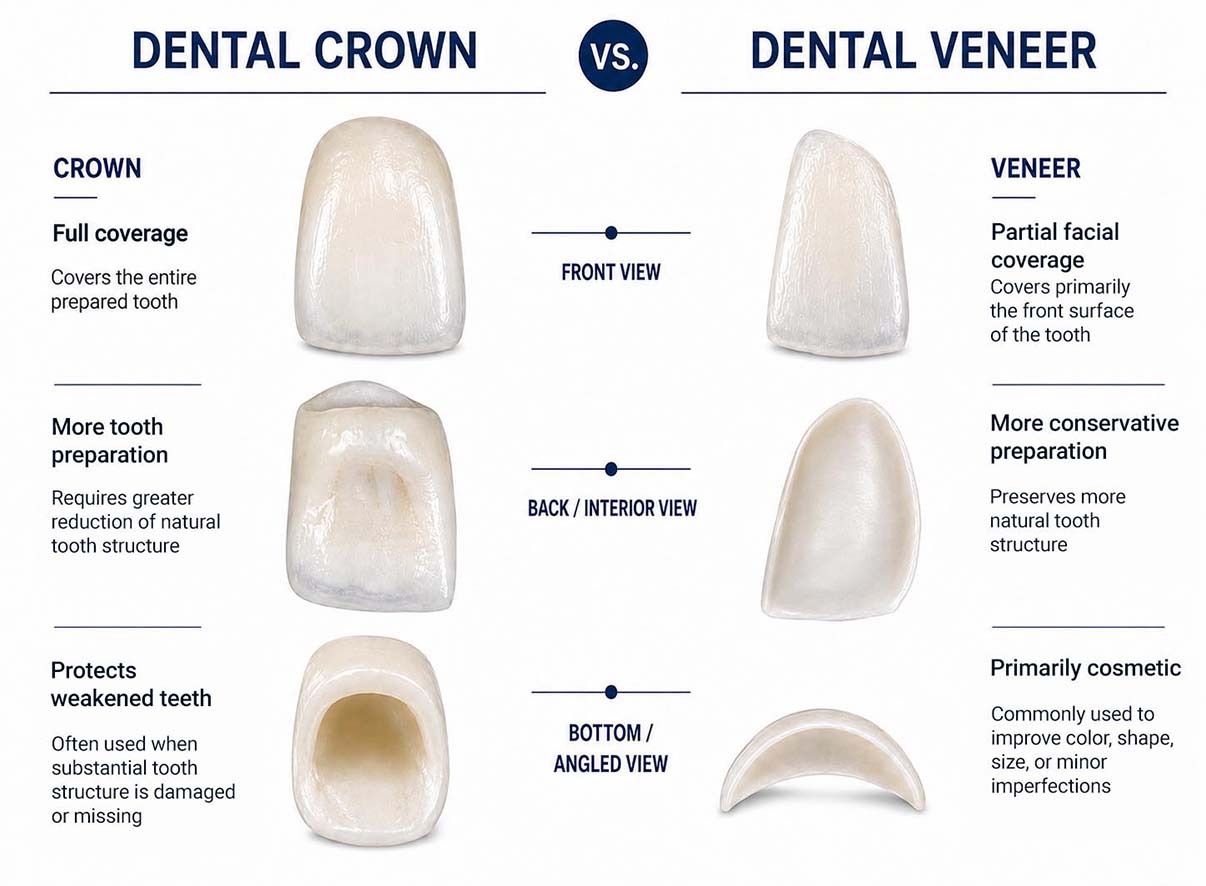
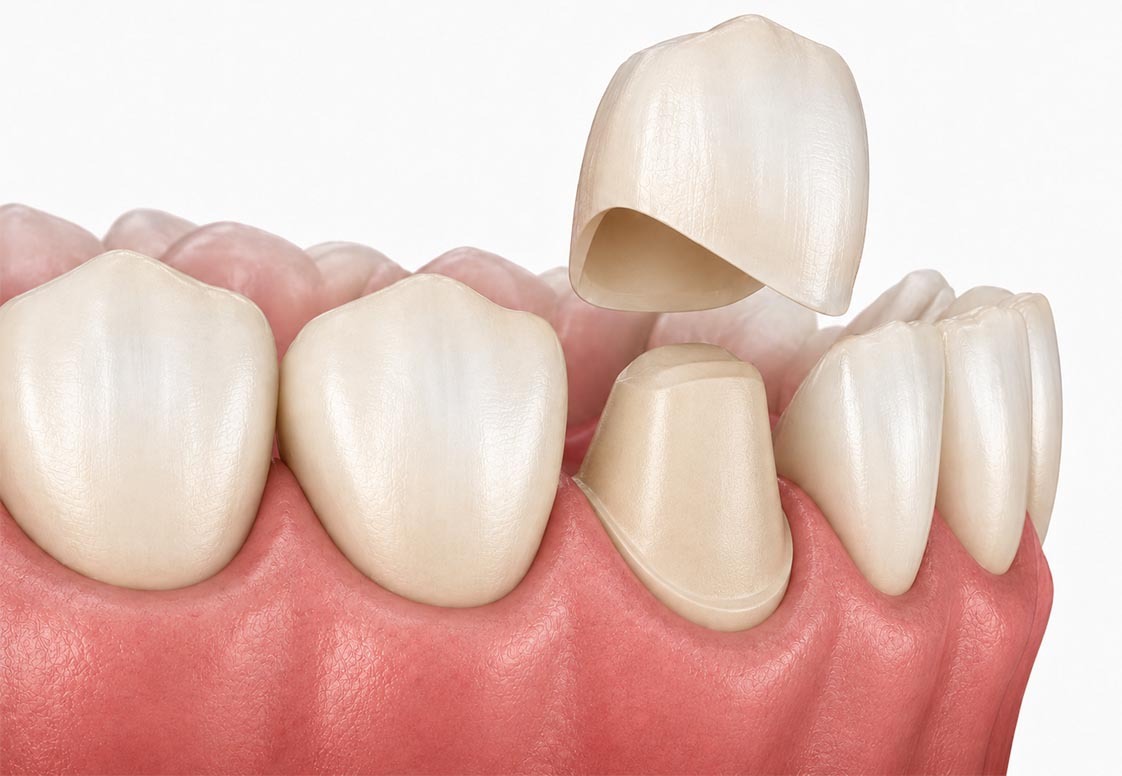
A dental crown is sometimes called a cap because it literally caps a tooth, covering it entirely. When you have a dental crown, none of the tooth underneath is visible. Instead, the crown is custom-made to fit over the tooth right down to the gum line.
Once the crown is fitted, it completely seals the tooth. A well-fitting crown ensures that no bacteria or food debris can enter the tooth. This is important because it helps protect and preserve the tooth underneath.
Read More: What Is the Difference between a Dentist and an Oral Surgeon?
When Is a Dental Crown Needed?
Your dentist may recommend fitting a crown on a front tooth if it is damaged or decayed and has lost a substantial part of its original structure. In this situation, a filling isn’t enough to restore it to full strength.
Crowns are frequently used to restore teeth that have received root canal therapy. This is because it is a severe tooth infection that often destroys much of the original tooth structure.
If you take a severe blow to the mouth, it can chip a tooth significantly, sometimes breaking it off near the gum line. In this case, your dentist may be able to fit a crown over the remaining tooth structure. Sometimes it’s necessary to expose more of the tooth during a crown lengthening procedure before the crown can be fitted successfully.
Sometimes a crown is used to cover a front tooth that is too small, for example, if it is peg-shaped or simply not the right size for your mouth. Crowns may also be suitable for covering teeth that are severely discolored or that are slightly out of alignment.
What Is a Front Tooth Crown Made from?
Dental crowns can be made from advanced ceramic materials and may be entirely metal-free. This ensures the best aesthetic results, so your front tooth crown should look and feel entirely natural.
Read More: 3 Types of Dental Implants
What Is the Process for Having a Dental Crown?
The process for a front tooth crown is very straightforward and usually requires at least two visits; it is briefly outlined below.
- Your tooth is numbed, so you feel no discomfort or pain during the process.
- Your dentist will carefully reshape the tooth, removing some tooth structure from right around the tooth, including the front, back, sides, and incisal edge. It’s necessary to remove quite a substantial amount of tooth structure to create enough room for the crown.
- After tooth preparation, your dentist takes a detailed dental impression. This is used to make your new crown.
- A temporary crown is fitted while your new crown is being made.
- Your new crown can be fitted during your second appointment, likely two weeks or more later.
Some dental offices have CAD/CAM technology, which allows them to make a new all-ceramic crown while you wait and fit it soon after your tooth is prepared, eliminating the need for a second visit.
Pros and Cons of Having a Front Tooth Crown
Pros can include:
- Protecting a severely damaged tooth and preventing further infection and decay.
- Covering a tooth that is too small or misshapen.
- Restoring a severely damaged tooth to full function, strength, and appearance.
Cons can include:
- Substantial tooth preparation is needed, and once tooth structure is removed, it never regrows. Having a dental crown is an irreversible process.
- Crowns can begin to leak as they age. You must have any crowns checked regularly to ensure they continue to protect the tooth underneath.
What are Veneers?
Natural-looking dental veneers are quite different from crowns because they only cover the front surface of a tooth. This can include the biting edge (incisal edge) and the sides of the tooth, but the back portion of the tooth nearest the tongue is left uncovered.
A veneer consists of a thin shell of material that is custom-made to cover the front of the tooth. It is not designed to offer any protection to the tooth; instead, it is purely to improve its appearance.
When Is a Veneer Recommended?
Your dentist may recommend a veneer if a front tooth is slightly chipped or cracked. Veneers are also used to hide teeth that are severely discolored, cannot be whitened topically, or are misshapen.
You can use the veneers to improve the appearance of teeth that are too small. They can also be used as an alternative to orthodontics, bringing slightly misaligned teeth back into line.

What Are Veneers Made from?
Most veneers are made from porcelain, but some can be made from composite resin.
Porcelain Veneers
Porcelain is generally preferred because it is durable, strong, and stain-resistant. These veneers are fabricated outside the mouth from a detailed dental impression.
Usually, the dentist must remove some tooth enamel to prepare the tooth for porcelain veneers. A typical porcelain veneer is 0.5 mm thick, so it’s necessary to remove this amount of material to create adequate space for the veneer to fit comfortably and look natural.
However, some veneers are prep-free or prepless. These are thinner than a typical veneer, at around 0.2 mm. Because these veneers are so thin, minimal or zero tooth preparation may be needed. The porcelain used to make these veneers is incredibly strong and long-lasting, but not everyone is a good candidate for this type of veneer.
Composite Resin Veneers
Composite resin veneers are made by applying the resin directly to the prepared tooth surface. Therefore, treatment can usually be completed in a single visit.
Usually, a little or no tooth preparation is needed, so in theory, composite resin veneers are reversible. However, composite resin isn’t as durable or as strong as porcelain and isn’t as stain-resistant.
This technique is sometimes referred to as cosmetic dental bonding.
Read More: 5 Things to Know Before Considering a Dental Bridge
What Is the Process for Having a Veneer?
The process for having a veneer is very straightforward, and the basic steps for porcelain veneers are outlined below.
Your teeth are numbed so the dentist can prepare them, removing a specific amount of tooth enamel and carefully shaping the teeth to receive the veneers.
A detailed dental impression is taken of your mouth, and your dentist will fit temporary veneers while your permanent veneers are made.
Once ready, you return to your dental office so your dentist can try in your new veneers, check they fit perfectly, before bonding them onto your teeth.
The process for having a composite resin veneer is slightly different and may not require your teeth to be numbed. Instead, your dentist may prepare the tooth surface by etching it, a process that slightly roughens the surface, creating a stronger bond between the composite resin and the tooth.
The etching fluid is removed, the tooth is dried, and your dentist will apply the composite resin directly to the tooth surfaces, hardening it with blue light as needed. Once all the resin is in place, your dentist carefully shapes and polishes it, completing your treatment.
Pros and Cons of Having a Veneer
Pros
- Veneers are ideal for anyone looking to perfect the appearance of their teeth, and their teeth are generally strong, healthy, and free from significant decay or damage.
- They can be ideal for people who wish to have a smile makeover.
- Porcelain veneers are longer-lasting and more durable, while composite resin veneers offer a more budget-friendly alternative but will not last as long.
Cons
- Often, veneers require healthy teeth to be prepared, removing tooth structure that can never grow back, and which could increase the risk of infection and decay in these teeth later.
- Some veneers, particularly composite resin veneers, are not as durable as crowns and may need replacing several years later.
Making the Choice between a Front Tooth Crown and a Veneer
As you can see, each of these restorations is used in specific circumstances. If you have a severely damaged tooth that needs protection, your dentist will recommend a crown that covers it entirely. If you only require cosmetic improvements to a front tooth, a veneer may be the most suitable option.
After examining your mouth, your dentist can suggest the most suitable restoration for your needs and which best preserves and protects your natural teeth. They can show you real examples of front-tooth crowns and veneers and talk you through all the different material options, helping you make the right decision.
Whether a crown or veneer is right for you depends on your tooth’s condition and your smile goals. At 505 Dental Associates, serving patients in Claremont and Co-op City, we can help you choose the best option. Schedule your consultation today and take the next step toward a confident smile.