
Having missing or failing teeth can cause multiple problems, affecting your oral health, overall health, and general sense of well-being, self-esteem, and confidence. Luckily, dental implant procedure can offer a long-lasting, even permanent, solution for tooth loss.
At 505 Dental Associates, patients can explore dental implant options designed to restore missing teeth and support a healthy, confident smile.
If you have just started investigating dental implants, there is a lot to learn, as many systems are available to suit single, multiple, or complete tooth loss. In this article, we explain what
a dental implant is and cover the three main types, helping you better understand this innovative treatment.
What Is a Dental Implant?
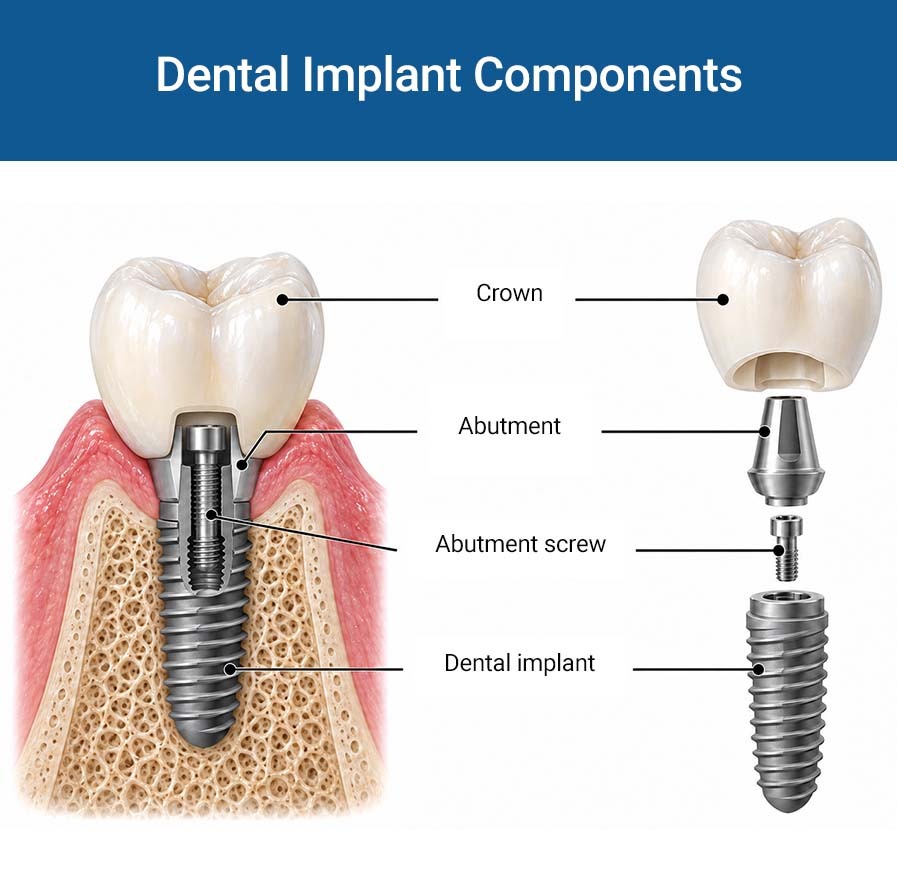
A dental implant is an artificial tooth root consisting of a small screw made from medical-grade titanium alloy or zirconia (a strong ceramic material), and which is inserted directly into your jawbone during a short oral surgery procedure.
An abutment, a special type of connector, is attached to the implant screw. This supports the implant restoration, which could be a crown, bridge, or denture.
Once the implant is inserted into your jawbone, it only takes a few short months for it to become firmly fused in place during a process called osseointegration. Once fused in position, the implant is strong and stable and easily able to support an implant restoration.
The great thing about dental implants is that they help protect your jawbone, preventing bone resorption that occurs naturally after tooth loss. This is important because it helps protect your oral health and any existing teeth, and implants are the only tooth loss solution that provides this valuable protection.
Read More: 5 Things to Know Before Considering a Dental Bridge
Understanding the Three Different Types of Implant Systems
There are three main types of implant systems, which are:
- Single Dental Implant Crown. Replacing a single missing tooth with a single dental implant crown.
- Dental Implant Bridge. Replacing two or more teeth with a dental implant bridge.
- Implant-Supported Denture. Replacing a complete arch of teeth with an implant-supported denture.
Single Dental Implant Crown
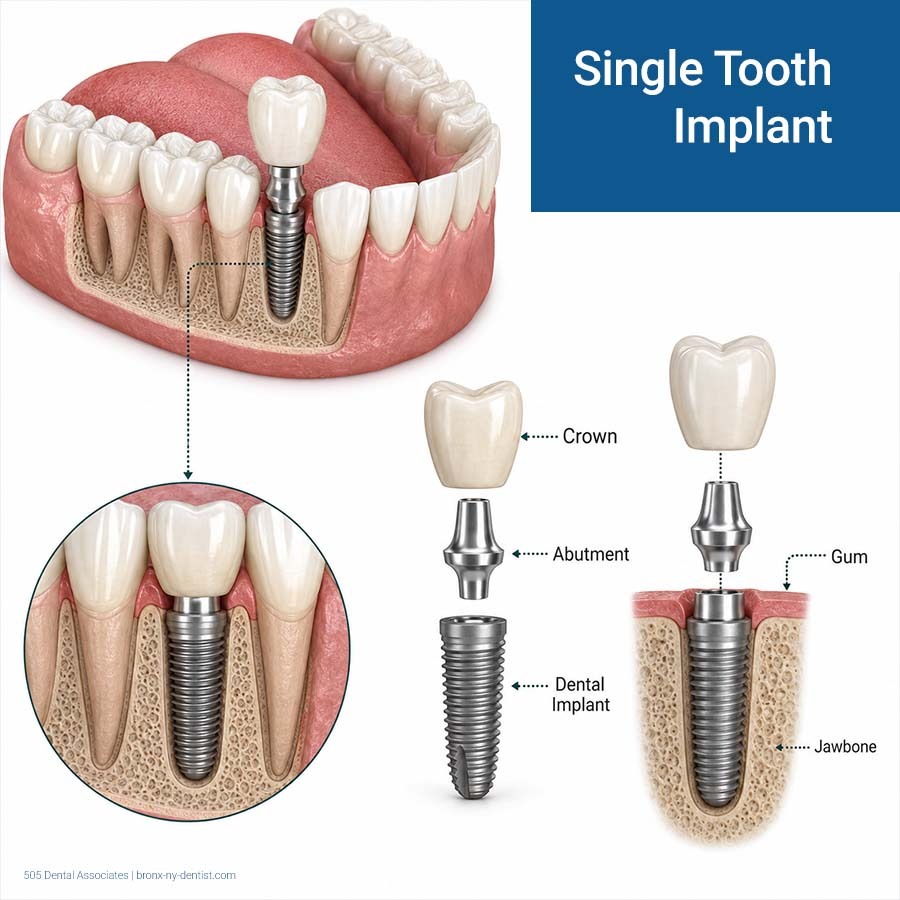
Dental implants are a popular solution for replacing a single missing tooth, replacing the entire tooth with an artificial implant screw that supports an implant crown. This treatment is preferable to a traditional dental bridge supported by natural teeth because it protects and preserves the adjacent teeth.
With a traditional bridge, the teeth on either side of the gap must be ground down and crowned. The crowns are attached to the replacement tooth, called a pontic, which is supported between them.
Although a traditional bridge is strong and stable, it’s always undesirable to grind down healthy teeth for support. It can increase the risk that they will become decayed and infected later as the crowns age and potentially leak.
A single dental implant eliminates this risk, protecting these teeth and helping to distribute the burden of biting and chewing. Also, single dental implant crowns look and feel just like natural teeth.
A well-designed implant crown will blend in seamlessly with the rest of your teeth, emerging from your gum just like a real tooth. It has biting and chewing strength similar to that of a natural tooth.
The implant crown is attached permanently to the screw and can only be removed by your dental implant dentist.
Read More: Front Teeth Crowns Vs. Veneers
Dental Implant Bridge
A dental implant bridge can replace several missing teeth that were originally adjacent to each other. It can even replace an entire arch of teeth.
With this option, it’s not necessary to replace every single tooth with a dental implant screw and crown. Instead, the bridge, which will look like a traditional bridge, is supported with dental implants.
The implant bridge has dental implant crowns that fit over the implant screws, supporting one or more replacement teeth or pontics between them. It provides a biting and chewing strength similar to natural teeth, allowing you to eat just about anything you wish.
Just like an implant crown, the bridge is attached permanently to the implant screws and is nonremovable.

Implant-Supported Denture
An implant-supported denture is a removable appliance, unlike an implant crown or bridge. It looks like a traditional denture but has special attachments on its fitting surface.
These special attachments clip onto the implants or onto a bar fitted over the implants. When you need to clean the denture, you simply snap it out of your mouth.
The advantage of an implant-supported denture is that it can replace an entire arch of teeth affordably. As few as two or four dental implants can hold the denture securely.
It helps eliminate many of the problems associated with a traditional denture, ensuring it stays firmly in place and cannot shift uncomfortably on the gums. An implant-supported denture also provides far greater biting and chewing strength than a traditional denture, so many foods that previously had to be avoided will be back on the menu.
Read More: What to Expect at Your Dental Filling Appointment
A Brief Overview of the Implant Process
Below is a very brief overview of what to expect if you have dental implants, but you will gain far more in-depth information during your initial consultation with an implant dentist.
1. Implant Consultation
During the initial consultation, your dentist will conduct a dental exam and review your dental and medical health to ensure you are a good candidate for implant surgery.
It is your chance to ask questions, see real-life examples of implant crowns, bridges, and dentures, and generally learn much more about treatment.
2. Diagnostics
Diagnostic tests will include digital X-rays and a cone beam CT scan, a 3-D scan of your jaws and any existing teeth. Your implant dentist may also wish to take digital photos and impressions of your mouth.
These are used to assess your jawbone and ensure it has sufficient strength to support the implants. If not, you may need a dental bone graft to help build up the amount of strong, healthy bone for implant placement.
The diagnostic tests are also used to create your custom treatment plan, identifying where each implant will be inserted, and to plan your implant restorations, ensuring they will function fully and look natural.
Once the plan is complete, a surgical stent is computer-generated and will be used during your implant placement.
3. Implant Placement
It is relatively quick to place dental implants, and if you only require a single implant, it could take as little as an hour. Your implant dentist can provide sedation dentistry if necessary to ensure you feel comfortable and relaxed, and will numb your mouth thoroughly before they begin.
The implants are placed using computer-guided surgery, in which your surgical stent is placed over your gums to guide your dentist and ensure the treatment plan is replicated precisely.
Once the implants are placed, your implant dentist may attach temporary teeth to the implants soon afterward. If this is impossible, they will provide a temporary restoration so you will not be left without teeth during healing.
Read More: What Is the Difference between a Dentist and an Oral Surgeon?
4. Healing
It typically takes 3 to 6 months for implants to heal with the jawbone and become firmly fused in place. During this time, you may need to follow a soft-food diet to ensure the implants are not disturbed during healing.
Your implant dentist will give you full instructions on what to expect during healing, how to look after your mouth, and suitable foods to eat.
5. Permanent Implant Restoration
After healing is complete, you return to your dental office so your permanent restoration can be made and fitted. Your implant dentist will ensure that you know how to keep your implants clean at home and will advise you on how frequently to schedule regular dental checkups and hygiene appointments.
Dental implants are simple to care for, but you must commit to a regular oral care routine. Following this routine will help ensure you enjoy your new implant teeth for many years to come, or for a lifetime.
Dental implants can be a great investment in your oral and overall health and in your smile.
Dental implants offer reliable solutions for replacing missing teeth, whether you need to restore one tooth, several teeth, or a full arch. At 505 Dental Associates, serving patients in Claremont and Co-op City, our team can help you understand your implant options and choose the right solution for your smile. Schedule a consultation today to take the first step toward restoring your smile.